Showing posts with label Poland. Show all posts

Friday, 3 April 2026

1710) Stanisław Wyspiański

Stanisław Mateusz Ignacy Wyspiański (1869 – 1907). Polish playwright, painter, poet, and interior and furniture designer. A patriotic writer, he created symbolic national dramas accordant with the artistic premises of the Young Poland movement.

Wyspiański was one of the most outstanding and multifaceted artists in Poland under the foreign partitions, and combined modernism with traditional Polish folk and Romantic themes.

 Wyspiański's artistic output is very eclectic. Among dramas and poetry, there are views of Cracow (drawings, sketch-books, oil-paintings, pastel drawings), portraits and self-portraits, designs of stained glass windows and paintings, illustrations, graphic art, and designs for furniture and interiors.


1709) Józef Mehoffer

Józef Mehoffer (1869 – 1946). Polish painter and decorative artist, one of the leading artists of the Young Poland movement and one of the most revered Polish artists of his time.

Mehoffer studied painting at the Academy of Fine Arts in Kraków, and later at the Academy of Fine Arts in Vienna and in Paris, at the Académie Colarossi. There Mehoffer began painting portraits, often of people of historical significance. He later expanded his work to include different techniques, such as graphic art, stained glass, textiles, chalk drawings, etchings and book illustrations. He produced set designs for theatre, and stylized furniture designs.

Mehoffer received international acclaim for his stained glass windows in the Gothic St Nicholas Collegiate Church in Fribourg, Switzerland produced in 1895–1936. He also produced many stained glasses for several churches in Poland and Austria. Mehoffer explored various media further throughout his career to include a range of applied arts in his projects. He manufactured a multiplicity of book covers, ornaments and posters. Mehoffer – aside from his versatility in studio art – became known for his frescoes often reminiscent of medieval art. 

In September 1899, Mehoffer married Jadwiga Janakowska, whom he had met five years earlier in Paris. They had a son, Zbigniew (1900–1985). Janakowska was the artist's muse and frequently posed for his portrait paintings.


Portrait by Stanisław Wyspiański 


1708) Marie Thérèse Zakrzewska

Marie Thérèse Zakrzewska, also known as Ata or Ama (1880? - 1920). Polish artists' model and noblewoman.

She was born (probably in Krakòw) into an aristocratic family and had a younger sister, Natalia. They were both known for their beauty. 

Ata was the favourite sitter of the painter Teodor Axentowicz, who made her famous in all artistic circles of Poland.

In 1903 she married Italian politician Alessandro Tasca Filangeri, Principe di Cutò (1874 - 1943), who was called "il principe rosso" (the red prince) because of his socialist ideas. The couple had two children: Gioia and Alessandro. One of Filangeri's sisters, Beatrice, was the mother of Giuseppe Tomasi di Lampedusa, author of the novel Il Gattopardo (The Leopard). 

Ata Zakrzewska and her daughter Gioia

Wiosna (The Spring), by Teodor Axentowicz

Rudowłosa (The Redhead), by Teodor Axentowicz


Poster for the 2nd exhibition of the Society of Polish Artists "Sztuka"  


Saturday, 7 March 2026

1703) Jadwiga of Poland

Jadwiga (1373 or 1374 – 1399), also known as Hedwig. First female monarch of the Kingdom of Poland, as well as its last hereditary ruler. She reigned from 16 October 1384 until her death. Born in Buda, she was the youngest daughter of Louis I of Hungary and Poland and his wife, Elizabeth of Bosnia. 

In 1386 she married Jogaila, Grand Duke of Lithuania, who took the Catholic baptismal name Władysław, Jadwiga died due to postpartum complications and as her only daughter predeceased her, the Queen was the last hereditary monarch of Poland. With her death, the throne of Poland became elective. 

In 1997, she was canonized by the Catholic Church.


- "Jadwiga was said to have been tall and beautiful with red hair."   https://www.galwaycathedral.ie/news/saint-month-st-jadwiga#:~:text=Jadwiga%20was%20said%20to%20have,establish%20a%20department%20of%20Theology.

Effigy of Jadwiga on her seal


Friday, 6 March 2026

1702) Faustina Kowalska

Maria Faustyna Kowalska of the Blessed Sacrament (born Helena Kowalska; 1905 – 1938). Polish Catholic religious sister and mystic. Faustyna, popularly spelled Faustina in English, had apparitions of Jesus Christ which inspired the Catholic devotion to the Divine Mercy, therefore she is sometimes called the "secretary" of Divine Mercy.

Throughout her life, Kowalska reported having visions of Jesus and conversations with him, which she noted in her diary, later published as The Diary of Saint Maria Faustina Kowalska: Divine Mercy in My Soul. 

At the age of 20 years, she joined a convent in Warsaw. She was later transferred to Płock and then to Vilnius. The Catholic Church canonized Kowalska as a saint on 30 April 2000. Her tomb is in the Divine Mercy Sanctuary, Kraków, where she spent the end of her life.


- "A red-haired, bouncing Polish baby girl named Helen certainly did when she was born 119 years ago today into the home of a poor, peasant family who had its priorities straight."   https://www.thedivinemercy.org/articles/happy-119th-birthday-st-faustina#:~:text=It%20helps%20to%20have%20a,who%20had%20its%20priorities%20straight.


- "I discovered a red-haired and freckled young woman who, before entering the convent, loved to dress fashionably!https://www.radiantmagazine.com/2019/02/18/my-friend-st-faustina/ 


Helena Kowalska before entering the convent

Portrait painting of Faustina Kowalska


Sunday, 26 March 2023

1539) Sidonia von Borcke

Sidonia von Borcke (1548–1620, also spelled Sidonie von Bork, Borke, or Borken). Pomeranian noblewoman who was tried and executed for witchcraft in the city of Stettin (today Szczecin, Poland). In posthumous legends, she is depicted as a femme fatale, and she has entered English literature as Sidonia the Sorceress.
In 1849 Oscar Wilde's mother, Jane Wilde, translated into English the Gothic romance Sidonia von Bork, die Klosterhexe, written by Wilhelm Meinhold and published in 1848. This English translation achieved a popularity in Great Britain that was unmatched by any other German book in British literary history. Especially in the Pre-Raphaelite Brotherhood, enthusiasm for Sidonia as a Medusa-type femme fatale was widespread. Several members created paintings based on the novel, the most famous being Sidonia Von Bork and Clara Von Bork by Burne-Jones in 1860.

Portrait of a Lady by Adriaen Thomasz Key (the sitter has been identificated as Sidonia von Borcke by Polish art historian Marcin Latka)


Sidonia von Borcke in her youth and old age (artist unknown, after Lucas Cranach the Elder)


Wednesday, 8 March 2023

1538) Stanislaw Reszka

Stanislaw Reszka (1544 - 1600). Polish Jesuit and diplomat.
He was secretary of King Stephen I Báthory and tutor of the future bishop of Warmia, Andrew Báthory. He was the founder of the hospital in Buk, his hometown. In 1592 he settled in Naples until his death.

Portrait by Adriaen Thomasz Key, identificated by Polish art historian Marcin Latka.


Friday, 2 September 2022

1515) Rufina Pukhova

Rufina Ivanovna Pukhova (1932 - 2021). Russian memoir writer.

She was the last wife of Kim Philby, a KGB double agent who rose in rank through British Intelligence along with the Cambridge Five. She met Philby through George Blake. Pukhova and Philby married in 1971. She is the author of The Private Life of Kim Philby: The Moscow Years (2000). Pukhova was born in Moscow to a Russian father and a Polish mother.
Before meeting Kim Philby, Pukhova worked as a copy editor in Russia.
 
- "Rufina was a red-haired beauty of 38 when she met Kim... She is now 61, with her red hair thinning." https://www-independent-co-uk
 
- "The funeral, attended by about 200 mourners led by Philby’s red-haired Russian wife, Rufa..." https://www.latimes.com/.../la-xpm-1988-05-13-mn-3510...


(PS: as you probably know, the name Rufina comes from the Latin rufus, red-haired).

Saturday, 27 August 2022

1510) Isabella Jagiellon

Isabella Jagiellon (1519 – 1559). Queen consort of Hungary. She was the oldest child of Polish King Sigismund I the Old, the Grand Duke of Lithuania and his Italian wife Bona Sforza.

In 1539, she married John Zápolya, Voivode of Transylvania and King of Hungary. At the time Hungary was contested between Archduke Ferdinand of Austria who wanted to add it to the Habsburg domains (see Royal Hungary), local nobles who wanted to keep Hungary independent, and Sultan Suleiman the Magnificent who saw it as a vassal state of the Ottoman Empire. While Isabella's marriage lasted only a year and a half, it did produce a male heir – John Sigismund Zápolya born just two weeks before his father's death in July 1540. She spent the rest of her life embroiled in succession disputes on behalf of her son. Her husband's death sparked renewed hostilities but Sultan Suleiman established her as a regent of the eastern regions of the medieval Kingdom of Hungary on behalf of her infant son. 
The region developed as a semi-independent buffer state noted for its freedom of religion. Ferdinand, however, never renounced his claims to reunite Hungary and conspired with Bishop George Martinuzzi who forced Isabella to abdicate in 1551. She returned to her native Poland to live with her family. Sultan Suleiman retaliated and threatened to invade Hungary in 1555–56 forcing nobles to invite Isabella back to Transylvania. She returned in 1556 and ruled as her son's regent until her death in 1559.
Her siblings were Sophia Jagiellon, Sigismund II Augustus, Anna Jagiellon, Catherine Jagiellon and Albert Jagiellon.
 
by Jacopino del Conte

Isabella Jagiellon Holding a Fan, after lost original by Titian or Jacopino del Conte

Isabella Jagiellon Holding a Zibellino, by Jacopino del Conte


1509) Hedwig Jagiellon

Hedwig Jagiellon (1513 – 1573). Member of the Jagiellonian dynasty as daughter of Sigismund I the Old of Poland. She was Electress of Brandenburg by marriage to Joachim II Hector, Elector of Brandenburg.

She was the eldest daughter of King Sigismund I the Old of Poland and his first wife, Hungarian Countess Barbara Zápolya, sister of the later King John I of Hungary. Her only full sibling, Anna, died at age 5. In 1515 Barbara Zàpolya died and King Sigismund remarried, and had six children with his second wife Bona Sforza. Although she grew up with her half brothers and sisters, Hedwig had personal tutors, and in the court she received the nickname of "reginula".

Her half siblings were: Anna JagiellonSophia Jagiellon, Isabella Jagiellon, Sigismund II Augustus, Catherine Jagiellon.

All paintings below are by Lucas Cranach the Elder but the last one.
 
Madonna and Child with Grapes

Madonna and Child with the Infant Saint John

Madonna and Child

Madonna lactans
Hedwig Jagiellon in a Black Dress, by Giovanni Cariani

1508) Stanisław of Masovia

Stanisław of Masovia (1501 – 1524). Polish prince member of the House of Piast in the Masovian branch. He was a Duke of Czersk, Warsaw, Liw, Zakroczym and Nur during 1503-1524 (under regency until 1518) jointly with his brother.

He was the eldest son of Konrad III the Red and his third wife Anna, a daughter of Mikolaj Radziwiłł the Old, Voivod of Vilnius and the first Grand Chancellor of Lithuania.
In their private lives, both Stanisław and his younger brother Janusz III were heavily inclined to drink and women; however, in order to continue his bloodline, in 1523 Stanisław started negotiations for marriage with Princess Hedwig of Poland, only surviving daughter of King Sigismund I and his first wife, Barbara Zápolya. The wedding never took place; one year later, and likely as a result of his dissolute lifestyle, Stanisław died in 1524.
The sudden death of Stanisław, and that two years later of his younger brother Janusz III, were considered suspicious at the time. According to cronichler Jan Długosz, the real cause of the death of both princes could be an inherited disease of the Masovian princes: tuberculosis.
Anna of Masovia, sister of Janusz and Stanisław, was the last representative of the line of Masovian-Piast.
 
by Hans Krell


1507) Stanisław Lubomirski

Stanisław Lubomirski (d. 1577). Polish nobleman and owner of the Sławkowice and Zabłocie estates.

In 1537 he married Laura de Effremis, from an old noble family of Bari (Italy). She died in 1542 and later Lubomirski married Barbara Hruszowska, with whom he had three children: Sebastian Lubomirski, Katarzyna Lubomirska and Anna Lubomirska.
 
by Giovanni Cariani


1506) Mikołaj "the Red" Radziwiłł

Mikołaj Radziwiłł, nicknamed The Red (1512 – 1584). Polish–Lithuanian nobleman, Count Palatine of Vilnius, Grand Chancellor of Lithuania, and Grand Lithuanian Hetman (from 1576) in the Grand Duchy of Lithuania and later in Polish–Lithuanian Commonwealth. Together with his cousin Mikołaj "the Black" Radziwiłł and the Radziwiłł family were granted title and position as Reichsfürst Prince of the Holy Roman Empire.

He became an advocate of Lithuanian sovereignty and thus a vocal opponent of political union with Poland, (Union of Lublin, 1569).
He was one of the most prominent converts and advocates of the Protestant faith in Polish–Lithuanian Commonwealth and his line of the family became devoted members and defenders of the Lithuanian Evangelical Reformed Church until its extinction.
He was immortalized in the epic poem Radivilias (1592).
Son of Jerzy "Herkules" Radziwiłł and Barbara Kolanka.
 
-"In order not to confuse him with his namesake, the cousins ​​​​were given the nicknames on account of the color of their hair. Nicolaus III is best known as "the Red"and his cousin as "the Black"." https://www.instagram.com/p/ChvId9ioCbq/
 
- "The nickname "Rudy", or "Red", was a reference to the color of his hair." https://en-academic.com/dic.nsf/enwiki/11735877
 
by Giovanni Cariani


Wednesday, 24 August 2022

1503) Sigismund II Augustus

Sigismund II Augustus (1520 – 1572). King of Poland and Grand Duke of Lithuania, son of Sigismund I the Old, whom Sigismund II succeeded in 1548. He was the first ruler of the Polish–Lithuanian Commonwealth and the last male monarch from the Jagiellonian dynasty.

Sigismund was the only son of Italian-born Bona Sforza and Sigismund the Old. From the beginning he was groomed and extensively educated as a successor. In 1529 he was crowned vivente rege while his father was still alive. Sigismund Augustus continued a tolerance policy towards minorities and maintained peaceful relations with neighbouring countries, with the exception of the Northern Seven Years' War which aimed to secure Baltic trade. Under his patronage, culture flourished in Poland; he was a collector of tapestries from the Low Countries and collected military memorabilia as well as swords, armours and jewellery. Sigismund Augustus' rule is widely considered as the apex of the Polish Golden Age; he established the first regular Polish navy and the first regular postal service in Poland, known today as Poczta Polska. In 1569 he oversaw the signing of the Union of Lublin between Poland and the Grand Duchy of Lithuania, which formed the Polish–Lithuanian Commonwealth and introduced an elective monarchy.
Sigismund Augustus married three times; his first wife, Elizabeth of Austria, died in 1545 at just eighteen. He was then involved in several relationships with mistresses, the most famous being Barbara Radziwiłł, who became Sigismund's second wife and Queen of Poland in spite of his mother's disapproval. The marriage was deemed scandalous and was fiercely opposed by the royal court and the nobility. Barbara died five months after her coronation, presumably due to ill health, however, rumours circulated that she was poisoned. Sigismund finally wedded Catherine of Austria, but remained childless throughout his life.
Following the death of his sister Anna in 1596 the Jagiellonian dynasty came to an end. Besides Anna, he had more siblings: Sophia Jagiellon, Isabella Jagiellon, Catherine Jagiellon and Albert Jagiellon.
 
by the circle of Tintoretto

 
by Tintoretto

by Jan Van Calcar

by Christoph Amberger


by Paris Bordone


Tuesday, 23 August 2022

1498) Saint Stanislaus Kostka

Stanisław Kostka (1550 – 1568). Polish novice of the Society of Jesus. He is venerated in the Catholic Church as Saint Stanislaus Kostka.

He entered the Society of Jesus in Rome on his 17th birthday (28 October 1567).
On the evening of the feast of Saint Lawrence (10 August), Stanislaus fell ill with a high fever, and clearly saw that his last hour had come. He wrote a letter to the Blessed Virgin begging her to call him to the skies there to celebrate with her the glorious anniversary of her Assumption (15 August). His confidence in the Blessed Virgin, which had already brought him many favours, was this time again rewarded; on 15 August 1568, towards 4:00 in the morning, while he prayed he died.
The Holy See ratified his beatification in 1605; he was canonized in 1726. St. Stanislaus is a popular saint of Poland, and many religious institutions have chosen him as the protector of their novitiates. The representations of him in art are quite varied; he is sometimes depicted receiving Holy Communion from the hands of angels, or receiving the Infant Jesus from the hands of the Virgin, or in the midst of a battle putting to flight the enemies of his country. At times he is depicted near a fountain putting a wet linen cloth on his breast. He is invoked for palpitations of the heart and for dangerous cases of illness.
On 15 August 2018 Pope Francis wrote to the Bishop of Płock in honor of the 450th anniversary of Stanislaus's death. In his message, Pope Francis cites a maxim of Stanislaus's: “Ad maiora natus sum – 'I was born for greater things'".
 
- "He was of middle stature, of a fair height, his hair dark auburn, his face gently rounded..." https://archive.org/.../storyofststanisl00cole_djvu.txt


1494) Barbara Kolanka

Barbara Kolanka or Barbara Kołówna h. Junosza (end of the 15th century–1550). Polish noblewoman.

She was the daughter of Paweł Koła, a prominent Polish politician. Her father was a Chamberlain (since 1490) and castellan of Halicz who in 1502 rose to the rank of Voivod of Podolia.
In 1515 she married Jerzy "Herkules" Radziwiłł. They had three children: Mikołaj "the Red" Radziwiłł, Anna Elżbieta Radziwiłł and Barbara Radziwiłł (1520–1551), who in 1547 secretly married king of Poland Sigismund II Augustus and was crowned the queen consort the following year.
 
All paintings below are by Lucas Cranach the Elder.
 
Judith with the Head of Holofernes

Princess from the Legend of Saint John Crysostom

Saint Barbara

Virgin and Child


Monday, 22 August 2022

1493) Elizabeth Jagiellon

Elizabeth Jagiellon (1482 - 1517). Thirteenth child of Casimir IV, King of Poland and Grand Duke of Lithuania and his wife Elizabeth of Austria. In 1515 she married Frederick II of Legnica.

In 1517 she gave birth to a daughter, who died two weeks after, followed by Elizabeth herself. 
 
Madonna lactans, by Lucas Cranach the Elder (or workshop)

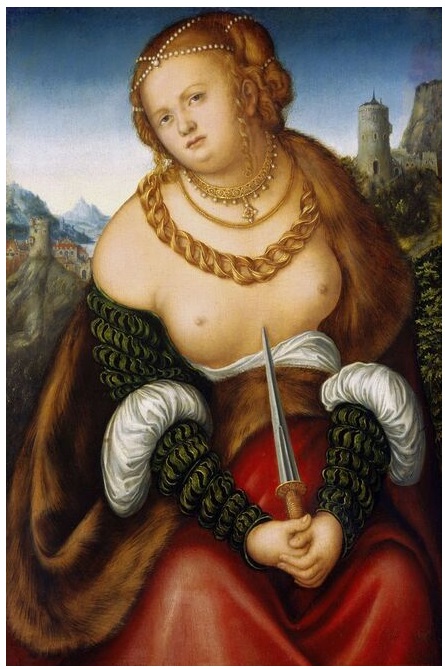
Lucretia, by Lucas Cranach the Elder (or workshop)

Lucretia, by Lucas Cranach the Elder (or workshop)


Sunday, 21 August 2022

1488) Anna of Masovia

Anna of Masovia (c. 1498 – 1557). Princess of Mazovia and a member of the House of Piast. She was the last representative of the line of Masovian-Piast.

She was the second daughter of Konrad III of Masovia and Anna Radziwiłł.
In 1536 she married Stanisław Odrowąż. They had one child, Sophia.
 
Anna of Masovia, by Bernardino Licinio

Anna of Masovia, by Lucas Cranach the Elder

Venus and Cupid by Lucas Cranach the Elder