Showing posts with label royalty. Show all posts

Wednesday, 6 May 2026

1713) Thutmose IV

Thutmose IV. 8th Pharaoh of the 18th Dynasty of Egypt, who ruled in approximately the 14th century BC. He was the son of Amenhotep II and Tiaa and the grandfather of Akhenaten.

The currently preferred reconstruction usually comes to an accession date around 1401 BC or 1400 BC for the beginning of Thutmose IV's reign. The length of his reign is not clear, but today most scholars ascribe him a 10-year reign from 1401 to 1392 BC, within a small margin of error.


- "His hair, which is parted in the middle, is about 16 cm (6.3 in) long and dark reddish-brown."  https://en.wikipedia.org/wiki/Thutmose_IV#Burial_and_mummy 

(As usual with many Egyptian mummies, it is not clear whether Thutmose IV's hair was naturally red/brown of if this colour was a consequence of the henna used during the embalming)

Statue of Thutmose IV and his mother Tiaa.


Wednesday, 12 March 2025

1653) Liu Yuan

Liu Yuan (died in 310), also known by his posthumous name as the Emperor Guangwen of Han (Zhao). Founding emperor of the Xiongnu-led Han-Zhao dynasty of China during the Sixteen Kingdoms period. Due to Tang dynasty naming taboo, he is referred to by his courtesy name as Liu Yuanhai in the Book of Jin.
With the dissolution of the Southern Xiongnu in 216, the last vestiges of their power were divided into Five Divisions in Bing province around modern-day Shanxi. Liu Yuan was born into the aristocracy of the Five Divisions and was sent to the Chinese capital, Luoyang as a hostage during his youth, where he became highly sinicized and later held several government offices under the Western Jin dynasty. As the War of the Eight Princes weakened Jin authority in northern China, Liu Yuan was called upon by the Five Divisions to lead their rebellion, and in 304, he declared independence from the Jin and founded the Han-Zhao dynasty, one of the first of the Sixteen Kingdoms. His declaration, along with the founding of the Cheng-Han dynasty in Sichuan that same year, marked the formal end of the Western Jin's brief unification of China following the Three Kingdoms period.


- "In the Book of Wei, Chinese author Wei Shou notes that Liu Yuan was over six feet tall and that he had strands of red hair in his long beard." https://en.wikipedia.org/wiki/Liu_Yuan_(Han-Zhao)#Physical_appearance 


Wednesday, 5 March 2025

1645) Al-Hakam II

Al-Hakam II, also known as Abū al-ʿĀṣ al-Mustanṣir bi-Llāh al-Hakam b. ʿAbd al-Raḥmān ( 915 – 976). Caliph of Córdoba. He was the second Umayyad Caliph of Córdoba in Al-Andalus, and son of Abd-al-Rahman III and Murjan. He ruled from 961 to 976.
Al-Hakam II succeeded to the Caliphate after the death of his father Abd-ar-Rahman III in 961. He secured peace with the Catholic kingdoms of northern Iberia, and made use of the stability to develop agriculture through the construction of irrigation works. Economic development was also encouraged through the widening of streets and the building of markets.
Hakam himself was very well versed in numerous sciences. He had books purchased from Damascus, Baghdad, Constantinople, Cairo, Mecca, Medina, Kufa, and Basra.
During his reign, a massive translation effort was undertaken, and many books were translated from Latin and Greek into Arabic. He formed a joint committee of Muwallad Muslims and Mozarab Catholics for this task.

- "Físicamente rubio, pero tirando a pelirrojo, con nariz aguileña, grandes ojos negros... [Physically blond, but almost red-haired, with an aquiline nose and large black eyes...]" https://es.wikipedia.org/wiki/Alhak%C3%A9n_II#Semblanza_del_Califa

- "Su cabello pelirrojo, ojos oscuros y tez clara revelaban una mezcla de sangres común en los omeyas andalusíes, pues su madre era una cristiana llamada Maryan. [His red hair, dark eyes and fair complexion revealed a mixture of blood common among the Andalusian Umayyads, as his mother was a Christian named Maryan.]" https://historia.nationalgeographic.com.es/a/califato-cordoba-esplendor-al-andalus_19598

- "Le sucedió su hijo Al Hakam II, que tomó de su padre el cabello pelirrojo y la tez clara... [He was succeeded by his son Al Hakam II, who took his father's red hair and fair complexion...]" https://memoriadelfuturo.eu/por-que-lamine-yamal-es-espanol-pero-himex-ii-era-moro/


Friday, 1 November 2024

1637) Marie Thérèse Antoinette Raphaëlle, Dauphine of France

Marie Thérèse Antoinette Raphaëlle, Dauphine of France (1726 – 1746). Daughter of King Philip V of Spain and Elisabeth Farnese and wife of Louis, Dauphin of France, son of King Louis XV. The Dauphine died aged 20, three days after giving birth to a daughter who died in 1748.


- "Although the Dauphine was described as beautiful, dignified, pious and well educated, negative remarks were made because of her red hair." https://en.wikipedia.org/wiki/Mar%C3%ADa_Teresa_Rafaela_of_Spain


Saturday, 2 September 2023

1597) John III of Sweden

John III (1537 – 1592). King of Sweden from 1569 until his death.
He was the son of King Gustav I of Sweden and his second wife Margaret Leijonhufvud. He was also, quite autonomously, the ruler of Finland, as Duke John from 1556 to 1563. In 1581 he assumed also the title Grand Prince of Finland. He attained the Swedish throne after a rebellion against his half-brother Eric XIV. He is mainly remembered for his attempts to close the gap between the newly established Lutheran Church of Sweden and the Catholic Church, as well as his conflict with and murder of his brother.
His first wife was Catherine Jagellonica of the Polish-Lithuanian ruling family, and their son Sigismund eventually ascended both the Polish-Lithuanian and Swedish thrones. After her death, he married Gunilla Bielke. They had a son, John, Duke of Finland.
With his mistress Karin Hansdotter he had at least four illegitimate children.

Unidentified painter

Portrait after Johan Baptista van Uther

Unidentified painter


1596) Anna Vasa of Sweden

Anna Vasa of Sweden (also Anne, 1568 – 1625). Swedish princess heavily involved in the politics of that country and of Poland. 

She was starosta of Brodnica and Golub. The youngest child of King John III of Sweden and Catherine Jagiellon, she was close to her brother Sigismund Vasa, King of Poland (1587–1632) and King of Sweden (1592–99). Raised a Catholic, Anna converted to Lutheranism in 1584.

Portrait by Lavinia Fontana

Portrait by Lavinia Fontana


Saturday, 27 August 2022

1510) Isabella Jagiellon

Isabella Jagiellon (1519 – 1559). Queen consort of Hungary. She was the oldest child of Polish King Sigismund I the Old, the Grand Duke of Lithuania and his Italian wife Bona Sforza.

In 1539, she married John Zápolya, Voivode of Transylvania and King of Hungary. At the time Hungary was contested between Archduke Ferdinand of Austria who wanted to add it to the Habsburg domains (see Royal Hungary), local nobles who wanted to keep Hungary independent, and Sultan Suleiman the Magnificent who saw it as a vassal state of the Ottoman Empire. While Isabella's marriage lasted only a year and a half, it did produce a male heir – John Sigismund Zápolya born just two weeks before his father's death in July 1540. She spent the rest of her life embroiled in succession disputes on behalf of her son. Her husband's death sparked renewed hostilities but Sultan Suleiman established her as a regent of the eastern regions of the medieval Kingdom of Hungary on behalf of her infant son. 
The region developed as a semi-independent buffer state noted for its freedom of religion. Ferdinand, however, never renounced his claims to reunite Hungary and conspired with Bishop George Martinuzzi who forced Isabella to abdicate in 1551. She returned to her native Poland to live with her family. Sultan Suleiman retaliated and threatened to invade Hungary in 1555–56 forcing nobles to invite Isabella back to Transylvania. She returned in 1556 and ruled as her son's regent until her death in 1559.
Her siblings were Sophia Jagiellon, Sigismund II Augustus, Anna Jagiellon, Catherine Jagiellon and Albert Jagiellon.
 
by Jacopino del Conte

Isabella Jagiellon Holding a Fan, after lost original by Titian or Jacopino del Conte

Isabella Jagiellon Holding a Zibellino, by Jacopino del Conte


1509) Hedwig Jagiellon

Hedwig Jagiellon (1513 – 1573). Member of the Jagiellonian dynasty as daughter of Sigismund I the Old of Poland. She was Electress of Brandenburg by marriage to Joachim II Hector, Elector of Brandenburg.

She was the eldest daughter of King Sigismund I the Old of Poland and his first wife, Hungarian Countess Barbara Zápolya, sister of the later King John I of Hungary. Her only full sibling, Anna, died at age 5. In 1515 Barbara Zàpolya died and King Sigismund remarried, and had six children with his second wife Bona Sforza. Although she grew up with her half brothers and sisters, Hedwig had personal tutors, and in the court she received the nickname of "reginula".

Her half siblings were: Anna JagiellonSophia Jagiellon, Isabella Jagiellon, Sigismund II Augustus, Catherine Jagiellon.

All paintings below are by Lucas Cranach the Elder but the last one.
 
Madonna and Child with Grapes

Madonna and Child with the Infant Saint John

Madonna and Child

Madonna lactans
Hedwig Jagiellon in a Black Dress, by Giovanni Cariani

1508) Stanisław of Masovia

Stanisław of Masovia (1501 – 1524). Polish prince member of the House of Piast in the Masovian branch. He was a Duke of Czersk, Warsaw, Liw, Zakroczym and Nur during 1503-1524 (under regency until 1518) jointly with his brother.

He was the eldest son of Konrad III the Red and his third wife Anna, a daughter of Mikolaj Radziwiłł the Old, Voivod of Vilnius and the first Grand Chancellor of Lithuania.
In their private lives, both Stanisław and his younger brother Janusz III were heavily inclined to drink and women; however, in order to continue his bloodline, in 1523 Stanisław started negotiations for marriage with Princess Hedwig of Poland, only surviving daughter of King Sigismund I and his first wife, Barbara Zápolya. The wedding never took place; one year later, and likely as a result of his dissolute lifestyle, Stanisław died in 1524.
The sudden death of Stanisław, and that two years later of his younger brother Janusz III, were considered suspicious at the time. According to cronichler Jan Długosz, the real cause of the death of both princes could be an inherited disease of the Masovian princes: tuberculosis.
Anna of Masovia, sister of Janusz and Stanisław, was the last representative of the line of Masovian-Piast.
 
by Hans Krell


Wednesday, 24 August 2022

1503) Sigismund II Augustus

Sigismund II Augustus (1520 – 1572). King of Poland and Grand Duke of Lithuania, son of Sigismund I the Old, whom Sigismund II succeeded in 1548. He was the first ruler of the Polish–Lithuanian Commonwealth and the last male monarch from the Jagiellonian dynasty.

Sigismund was the only son of Italian-born Bona Sforza and Sigismund the Old. From the beginning he was groomed and extensively educated as a successor. In 1529 he was crowned vivente rege while his father was still alive. Sigismund Augustus continued a tolerance policy towards minorities and maintained peaceful relations with neighbouring countries, with the exception of the Northern Seven Years' War which aimed to secure Baltic trade. Under his patronage, culture flourished in Poland; he was a collector of tapestries from the Low Countries and collected military memorabilia as well as swords, armours and jewellery. Sigismund Augustus' rule is widely considered as the apex of the Polish Golden Age; he established the first regular Polish navy and the first regular postal service in Poland, known today as Poczta Polska. In 1569 he oversaw the signing of the Union of Lublin between Poland and the Grand Duchy of Lithuania, which formed the Polish–Lithuanian Commonwealth and introduced an elective monarchy.
Sigismund Augustus married three times; his first wife, Elizabeth of Austria, died in 1545 at just eighteen. He was then involved in several relationships with mistresses, the most famous being Barbara Radziwiłł, who became Sigismund's second wife and Queen of Poland in spite of his mother's disapproval. The marriage was deemed scandalous and was fiercely opposed by the royal court and the nobility. Barbara died five months after her coronation, presumably due to ill health, however, rumours circulated that she was poisoned. Sigismund finally wedded Catherine of Austria, but remained childless throughout his life.
Following the death of his sister Anna in 1596 the Jagiellonian dynasty came to an end. Besides Anna, he had more siblings: Sophia Jagiellon, Isabella Jagiellon, Catherine Jagiellon and Albert Jagiellon.
 
by the circle of Tintoretto

 
by Tintoretto

by Jan Van Calcar

by Christoph Amberger


by Paris Bordone


1502) Grand Duke Michael Pavlovich of Russia

Grand Duke Michael Pavlovich of Russia (1798 - 1849). Russian prince, tenth child and fourth son of Paul I of Russia and Sophie Dorothea of Württemberg.

In 1824, Michael married his first cousin once removed, Princess Charlotte of Württemberg (1807–1873), the daughter of Prince Paul of Württemberg and Princess Charlotte of Saxe-Hildburghausen. Charlotte took the name Elena Pavlovna upon converting to Orthodoxy. They had five daughters.
Mikhailovsky Palace was built by Carlo Rossi for Grand Duke Michael between 1819–1825. The Palace now holds the Russian Museum.
Michael's great-great-great-grandson Duke Georg Borwin of Mecklenburg is the current head of the House of Mecklenburg-Strelitz.
Brother of Alexander I of Russia


1500) Maria of Alania

Maria of Alania (born Martha; 1053–1118). Byzantine empress by marriages to emperors Michael VII Doukas and Nikephoros III Botaneiates.

Her status as empress was considered a significant success for a newly unified Kingdom of Georgia, which would achieve regional influence comparable to that of Byzantium only during the reign of Martha's nephew, King David IV, who refused to carry a Byzantine title. Maria was the only non-Byzantine empress of the eleventh century.
 
- "After rejecting a proposal from Eudocia Macrembolitissa , he chose the "beautiful Maria" of Alania, she of the red hair, the alabaster skin, and the bright blue eyes." https://www.encyclopedia.com/.../anna-dalassena-c-1025-1105


Tuesday, 23 August 2022

1496) Abdulmejid I

Abdulmejid I (1823 – 1861). 31st Sultan of the Ottoman Empire and succeeded his father Mahmud II on 2 July 1839.
He was born at the Beşiktaş Palace or at the Topkapı Palace, in Istanbul. His mother was his father's first wife in 1839, Valide Sultan Bezmiâlem.
Abdulmejid received a European education and spoke fluent French, being the first sultan to do so. Like Abdülaziz who succeeded him, he was interested in literature and classical music.
His biggest achievement was the announcement and application of the Tanzimat (reorganization) reforms which were prepared by his father and effectively started the modernization of the Ottoman Empire in 1839. For this achievement, one of the Imperial anthems of the Ottoman Empire, the March of Abdulmejid, was named after him.


1495) Bezmiâlem Sultan

Bezmiâlem Sultan (c. 1807 – 1853). Ninth consort of Sultan Mahmud II, and Valide Sultan to their son, Sultan Abdulmejid I of the Ottoman Empire.

She was born in Georgia and belonged to the Machabeli princely family.
She married Sultan Mahmud in 1822, and was given the title of "Fifth Kadın". In 1823, she gave birth to her only son, Şehzade Abdulmejid. (later Abdulmejid I).
Like other influential Ottoman women, Bezmiâlem was a patron of arts and architecture.
 
- "She was known for her extremely pale complexion and her reddish blonde hair." https://en.wikipedia.org/wiki/Bezmi%C3%A2lem_Sultan


Monday, 22 August 2022

1493) Elizabeth Jagiellon

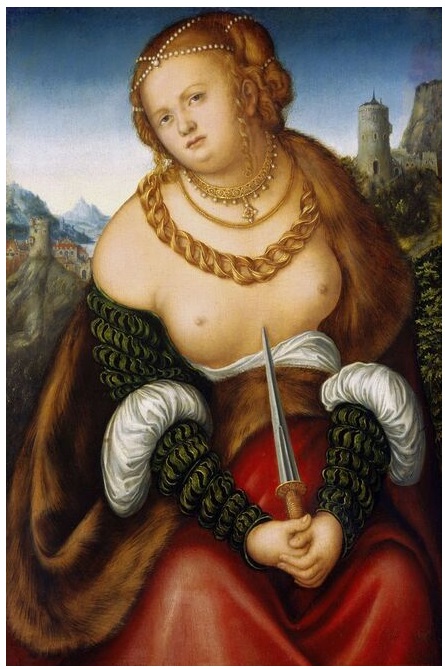
Elizabeth Jagiellon (1482 - 1517). Thirteenth child of Casimir IV, King of Poland and Grand Duke of Lithuania and his wife Elizabeth of Austria. In 1515 she married Frederick II of Legnica.

In 1517 she gave birth to a daughter, who died two weeks after, followed by Elizabeth herself. 
 
Madonna lactans, by Lucas Cranach the Elder (or workshop)

Lucretia, by Lucas Cranach the Elder (or workshop)

Lucretia, by Lucas Cranach the Elder (or workshop)


1492) Tawhida Hanim

Tawhida Hanim (1850 – 1888). Egyptian princess and member of the Muhammad Ali dynasty.

She was the eldest daughter of Khedive Isma'il Pasha, and his first wife Shehret Feza Hanim.
In April 1869, Tawhida married Mansur Yeghen Pasha, son of Ahmad Pasha, descendant of a brother of Muhammad Ali Pasha.
 
- "She had beautiful auburn hair and green eyes, was slim, of medium height, and had great charm, enhanced by a remarkable intelligence." https://en.wikipedia.org/wiki/Tawhida_Hanim


1491) Dürrüşehvar Sultan

Durru Shehvar Durdana Begum Sahiba, Princess of Berar (born Hatice Hayriye Ayşe Dürrüşehvar Sultan; 1914 – 2006). Ottoman princess, only daughter of Abdulmejid II, who was the last heir apparent to the Ottoman Imperial throne and the last Caliph of the Ottoman Caliphate.

Highly respected and well-educated lady, the princess was fluent in French, Turkish, English and also Urdu. She was also a painter and a poet.
In 1931, her father arranged her marriage to Azam Jah, elder son and heir to Mir Osman Ali Khan. The two married at Villa Carabacel in Nice. 
 
- "Philip Mason, of the Indian Civil Service, described her as "a commanding figure, handsome of feature, with a clear fair complexion and auburn hair… No one could ignore her or slight her." https://en.wikipedia.org/.../D%C3%BCrr%C3%BC%C5%9Fehvar...


1489) Maud of Wales

Maud of Wales (1869 – 1938). Queen of Norway as the wife of King Haakon VII. She was the youngest daughter of King Edward VII and Queen Alexandra of the United Kingdom. Before her marriage, she was known as Princess Maud of Wales because her father was Prince of Wales at the time.

Maud, along with her sisters, Victoria and Louise, received the Imperial Order of the Crown of India from their grandmother Queen Victoria on 6 August 1887. Like her sisters, she also held the Royal Order of Victoria and Albert (First Class) and was a Dame Grand Cross of the Order of the Hospital of St. John of Jerusalem.
 
- "Maud and her sisters, who all inherited their mother’s auburn hair..." http://crownstiarasandcoronets.blogspot.com/.../maud-of...


Sunday, 21 August 2022

1488) Anna of Masovia

Anna of Masovia (c. 1498 – 1557). Princess of Mazovia and a member of the House of Piast. She was the last representative of the line of Masovian-Piast.

She was the second daughter of Konrad III of Masovia and Anna Radziwiłł.
In 1536 she married Stanisław Odrowąż. They had one child, Sophia.
 
Anna of Masovia, by Bernardino Licinio

Anna of Masovia, by Lucas Cranach the Elder

Venus and Cupid by Lucas Cranach the Elder


1487) Sophie of Brandenburg-Ansbach-Kulmbach

Sophie of Brandenburg-Ansbach-Kulmbach (1485 – 1537). Princess of Brandenburg-Ansbach and, by marriage, Duchess of Legnica.

Sophie was a daughter of the Margrave Frederick the Elder of Brandenburg-Ansbach and Bayreuth (1460–1536) from his marriage to Sophia of Poland ( 1464–1512), daughter of King Casimir IV of Poland.
She married on 24 November 1518 the Duke Frederick II of Legnica in Silesia (1480–1547).
Sophie is not to be confused with her eponymous niece (1535–1587), who was also Duchess of Legnica.
 
All the paintings below are by Lucas Cranach the Elder.
 
Lucretia

Madonna and Child

Madonna and Child

Madonna and Child

Venus